rapunzl logo green investing castle
Request Free DemoFree Demo
rapunzl mobile hamburger icon
Rapunzl
Educators
Districts
After-School
Parents
Courses
Investment Simulator
Teacher Portal
Integrated Curriculum
Real-Time Market Data
Certifications
Partners
About Us
Blog
Contact
Simulator Login
Educator Login
Get Free Demo
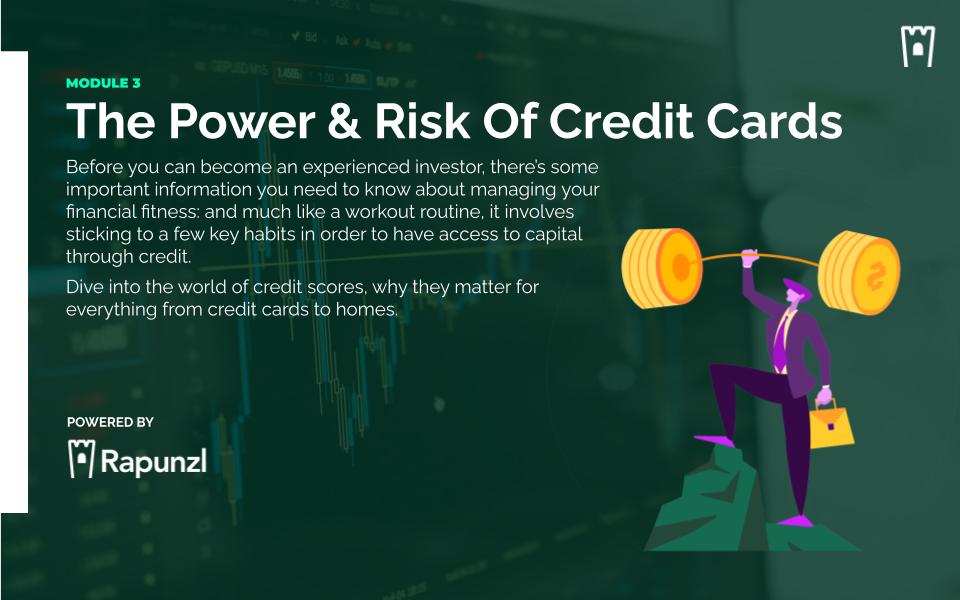
The Power & Risks Of Credit cover graphic for the Rapunzl personal finance curriculum
Module 3

The Power & Risks Of Credit

Before you can become an experienced investor, you need to know about managing your financial fitness. Much like a workout routine, it involves sticking to a few key habits in order to have access to capital through credit.
Dive into the world of credit scores, why they matter for everything from credit cards to homes.

Module At A Glance

Grade Levels:
7th - 12th
Est. Length:
3 - 4.5 Hours (22 slides)
Activities:
8 Activities
Articles:
9 Articles
Languages:
English & Spanish
Curriculum Fit:
Math, Business, Economics, CTE, Social Studies
Standards Alignment:
CEE National Standards, Jump$tart National Standards & Relevant State Standards
magnifying glass with stock chart

Guiding Questions

  • What is a credit score and why is it important?
  • How are you able to keep a good credit score while still utilizing personal debt?
  • Why do people use credit cards?
  • How do credit cards actually work behind the scenes?
  • When is it beneficial to use a credit card to purchase something? When is it not?
  • What are the risks of using a credit card versus paying immediately for something?
  • What are your rights as a borrower?

Enduring Understandings

  • Credit scores are a critical aspect of financial independence.
  • Lenders use credit scores to determine everything from renting an apartment to how much interest is on your credit card debt.
  • Credit cards can be useful if properly utilized, however can be extremely dangerous to your financial health if improperly used.
  • For most purchases, there is no need to use a credit card unless you have money to pay it off.
  • If you get in over your head in debt, there are still things you can do as a borrower to alleviate the mounting debt.

Module Vocab & Key Topics

Credit Card
A type of payment card that allows consumers to purchase goods and services on credit. It is issued by a financial institution such as a bank or credit union, and can be used to make purchases in person or online.
Credit Limit
The maximum amount of money that a consumer can borrow on their credit card. This may also be called the “credit line” or “line of credit”.
Consumer Debt
Consumer debt includes any debt incurred for non-business related purchases such as credit cards, medical bills, installment loans, and other consumer spending. High levels of consumer debt can lead to difficulty in making payments and delinquency or default on loans.
Debt Consolidation Loan
A debt consolidation loan is when multiple debts are grouped into one larger loan that has hopefully a lower interest rate and more manageable payment than multiple smaller ones.
Payday Loans
Payday loans are short term loans with extremely high interest rates given out with minimal restrictions; these types of loans are considered very predatory due to their costliness and should be avoided unless absolutely necessary.
Credit Score
A numerical representation of an individual's creditworthiness, based on their past borrowing and repayment history. Generally, the higher the score, the more likely it is that a consumer will be approved for loans and other forms of credit.
Annual Percentage Rate (APR)
Average annual cost of borrowing money, including interest charges and fees associated with a particular credit card or loan product expressed as a single percentage number.
Balance Transfer Fees
A fee charged when transferring balances from one credit card to another (i.e., when consolidating debt). This often comes in addition to applicable interest rates; however, some cards offer zero-percent balance transfer offers with no fees at all if done within a certain time period after approval/activation of the new account.
Cash Advance Fees
A fee charged when withdrawing cash from an ATM using your credit card instead of your bank account or debit card—typically 2-5% of the transaction amount, plus any applicable ATM fees from the receiving institution itself (the ATM owner).
Late Payment Fees
A fee charged by lenders for late payments on your account balance—typically $25-35 per missed payment depending on issuer policy and/or outstanding balance amount/activity since last statement date(s). The amount of time before a late payment fee is called the grace period, which is typically 25-30 days after the close of the billing cycle.
Minimum Payment Due
The smallest dollar amount that must be paid each month on your loan or credit card debt in order to avoid additional late payment penalties and keep your account current with respect to borrower obligations outlined in terms & conditions documents at time account was opened/activated/approved by lender/issuer respectively.
Credit Utilization Ratio
A ratio used to measure how much of your available credit you are utilizing at any given time; lower ratios indicate better overall management of debt while higher ratios may trigger warnings or higher interest rates from lenders/issuers in some circumstances.


Worked Examples

Credit In Action

Four ways a credit card's math works for you or against you — the same APR, read four ways.

Figures current · August 2026

Minimum trap

Paying the Minimum Never Ends

interest = balance × APR ÷ 12charged each month

Carry $5,000 at the average 22.15% card APR and pay only the minimum — interest plus 1% of the balance. Because the minimum shrinks as the balance does, clearing it takes 19 years and $8,159 in interest. Hold the payment flat at $150 and the same debt is gone in 4.4 years.

19 yearsto clear $5,000 at the minimumflat $150/mo: 4.4 years

yr 0yr 10yr 20$0$5,000fixed $150minimum

A minimum pegged to the balance shrinks as the balance does, so the payoff stretches for years and the interest outruns the original charge.

Daily rate

How Card Interest Compounds

DPR = APR ÷ 365daily periodic rate

Take a $2,000 balance carried at a 24% APR. The daily periodic rate is the APR split over 365 days, and interest posts on each day's balance — so today's interest joins tomorrow's principal. Run that loop for a year and the true cost climbs from 24% to 27.1%.

27.1%effective annual rate on a 24% cardsticker APR: 24%

$29.80 at 18%$29.80 at 18%$39.83 at 24%$39.83 at 24%$49.91 at 30%$49.91 at 30%

Charged on each day's balance, a card's interest compounds daily, so its effective annual rate lands above the sticker APR.

Utilization

The Ratio Your Score Watches

utilization = balance ÷ limit0 to 100%

Utilization is the balance divided by the credit limit. On one $3,000 limit, a $300 balance is 10%, $1,500 is 50%, and $2,700 is 90%. Scoring models weigh the ratio itself, not the dollar amount, and generally read lower utilization as lower risk.

90%utilization at $2,700 of a $3,000 limit$300 → 10%

$300$300 · 10%10%$1,500$1,500 · 50%50%$2,700$2,700 · 90%90%

On a fixed limit, utilization rises in direct proportion to the balance — the less of the line you use, the lower the ratio a score reads.

Grace period

Pay in Full, Pay No Interest

interest = 0 when paid in fullinside the grace period

Pay the statement in full by the due date and the grace period sets the interest term to zero. Carry the same $1,000 instead and it accrues daily at 22.15% — about $248 over a year — while new purchases lose their grace period too.

$0interest when paid in full$248 carried a year

Paid in full  $1,000 spent  $0 interestCarried a year  $1,000 spent  $248 interest

Cleared inside the grace period, the interest term is exactly zero — the month's purchases become a 30-day interest-free loan.

Source: Federal Reserve G.19 Consumer Credit release, August 7, 2026 — average APR on credit-card accounts assessed interest, 22.15% for Q2 2026 (checked 2026-08-24). All other figures are derived from the balances and limits shown. Reviewed August 2026.