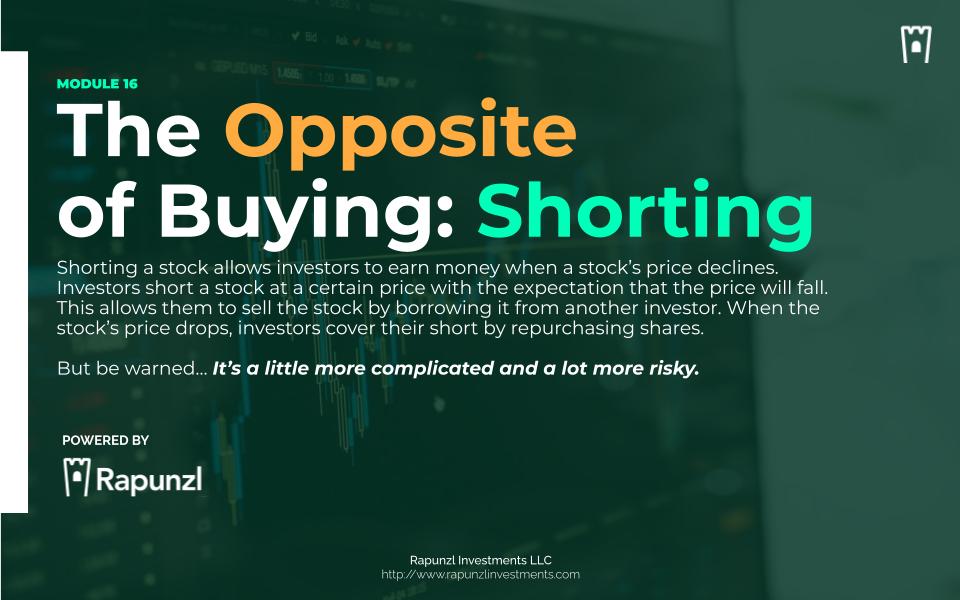
In this module, we explore how shorting a stock allows investors to earn money when a stock’s price declines. Investors short a stock at a certain price with the expectation that the price will fall. This allows them to sell the stock by borrowing it from another investor.
We cover the basics and also explore the infinite risk, highlighting why shorting is not a safe investing practice for most investors.
Module At A Glance
Grade Levels:
6th - 12th
Est. Length:
1-3 Hours (14 slides)
Activities:
1 Activities
Articles:
5 Articles
Languages:
English & Spanish
Curriculum Fit:
Math, Business, Economics, CTE, Social Studies
Standards Alignment:
CEE National Standards, Jump$tart National Standards & Relevant State Standards
Guiding Questions
How do investors choose what to invest in and what happens if the investor believes a stock price will decline?
What does it mean to short a stock and how can investors leverage shorting as a tool?
How do investors make money from shorting?
What are the risks associated with shorting?
Why is shorting a stock more risky than just owning a stock and hoping the price increases?
Enduring Understandings
Shorting can be thought of as the opposite of investing, because an investor will earn a profit if the price per share decreases instead of increasing.
Shorting occurs on margin, which means investors who short a stock use debt to do so, because they must first borrow the stock.
For inexperienced investors, shorting can lead to significant losses.
When shorting a stock, your risk is unlimited because a stock’s price can increase infinitely.
Module Vocab & Key Topics
Shorting A Stock
Shorting a stock involves borrowing shares to sell them with the expectation that the price will drop, allowing repurchase at a lower rate to earn a profit.
Covering A Short
The act of repurchasing the borrowed shares to return them to the lender, ideally at a lower price, is known as covering a short.
Margin Account
This is a specialized brokerage account used for shorting stocks that provides assurance to the brokerage firm that any losses from shorting will be covered.
Dividend
A payment made by a corporation to its shareholders. In the context of shorting, the short-seller is liable to pay dividends on the borrowed shares, not receive them.
Ex-Dividend Date
The date by which an investor must own a stock to receive its next dividend. For a short seller, not closing their position by this date makes them liable to pay the dividend.
Margin Call
A demand from a broker to deposit more money or securities into a margin account to cover potential losses.
Short Squeeze
A situation where a lack of supply and an excess demand for a stock forces its price upwards, trapping short-sellers who may then need to cover their positions at a loss.
Unlimited Losses
A potential risk in shorting stocks, as there's no limit to how much a stock price can increase, leading to potentially unlimited financial liability for the short seller.
Margin Interest
The interest that accrues in a margin account for the period a short position is open, and it is deducted from any gains made from the short.
Stockbrokers
Professionals or firms authorized to buy and sell stocks. In the context of shorting, stockbrokers lend shares to investors.
Financial Ineptitude
Signs or indicators that a company is financially unstable or poorly managed, often considered a potential reason to short its stock.
Risk Management
The practice of identifying potential risks in advance and taking steps to mitigate them. Critical for short-selling due to its inherently risky nature.
Worked Examples
Short Selling In Action
Four pictures of a trade whose math runs backwards — and whose risk does too.
Figures current · August 2026
01Short P&L
Selling High to Buy Low
profit = (sell − buy) × sharesthe trade, reversed
Short 100 shares at $50: you borrow the shares and sell them first. Later you cover — buy them back — at $30. Profit is (sell − buy) × shares, the ordinary trade with its two prices swapped in order, so the same drop that costs a $50 buyer $2,000 pays the short $2,000.
$2,000profit shorting 100 shares to $30a $50 buyer loses $2,000
→A short position gains when the price falls — the ordinary trade run in reverse.
02Asymmetric risk
Capped Gain, Uncapped Loss
max loss is unboundedprice has no ceiling
Short 100 shares at $50. The price can fall at most to $0, capping the gain at (50 − 0) × 100 = $5,000. Upward there is no such floor: the loss is $5,000 at $100, $10,000 at $150, and keeps growing as the price climbs — (50 − price) × 100 has a top but no bottom.
+$5,000the most a 100-share short can gainloss above entry has no limit
→A stock can only fall to zero but can rise without limit, so a short's loss has no ceiling.
03Margin
Collateral to Borrow Shares
equity ≥ maintenance % × position valuemaintenance margin
Shorting sells borrowed shares, so a margin account must post collateral. At a 30% maintenance margin, a $5,000 short — 100 shares at $50 — must be backed by at least 0.30 × 5,000 = $1,500 of equity. Let the price rise to $65 and the position is worth $6,500, so the required equity climbs to $1,950.
$1,500equity to back a $5,000 short$1,950 once the price hits $65
→Shorting is done with borrowed shares, so it requires collateral that a rising price can erode.
04The squeeze
Losses That Feed Themselves
loss = (Pₜ − P₀) × sharesillustrative path
Say a squeeze forces the price up from $50 — to $60, $75, $95, $125, then $170 — as trapped shorts scramble to cover. Loss is (Pₜ − P₀) × 100 at each step: $1,000, $2,500, $4,500, $7,500, $12,000. The buying that covers one short is demand that lifts the price toward the next.
$12,000loss after a squeeze to $170100 shares shorted at $50
→As a shorted price rises, forced buying can push it higher still — loss compounding on itself.
Illustrative trades; all profit-and-loss and margin figures derived from the prices shown. Reviewed August 2026.